

Take a look at what’s new from HubSpot's Spring Spotlight!
Spring Spotlight is HubSpot’s biannual product showcase, where new features and meaningful platform updates are announced across marketing, sales, and service. It’s designed to help customers and partners understand not just what’s new, but how the platform is evolving to support modern go‑to‑market teams.
>> Subscribe to our monthly newsletter for more updates like these!
The way businesses attract, engage, and convert buyers is changing faster than it has in years.
Some of those changes show up as new product capabilities and platform improvements, as businesses update their technologies to adapt to changing behavior. Others reflect broader shifts in go‑to‑market strategy, as teams adjust how they meet customers, influence discovery, and support buying decisions.
This Special Edition HubSpot Product Update focuses on how HubSpot is responding to those strategic shifts through product innovation.
Rather than a standard monthly roundup, this edition highlights three key updates released as part of HubSpot’s Spring Spotlight, showcasing how the platform continues to evolve across marketing, sales, and customer support.
TL;DR - Special Updates
-
Marketing: Expanded AEO visibility into how brands appear in real AI answers
-
Sales: End‑to‑end, signal‑based prospecting with enhanced Prospecting Agent
- Service: lower-risk adoption and expanded controls for Customer Agent
1) HubSpot Introduces New AEO Tool for AI‑Driven Discovery
>>This feature is available on Professional and Enterprise tiers across Marketing Hub.
Answer Engine Optimization (AEO) isn’t new—but its role in buyer discovery has changed.
Over the past year, teams have been preparing for a world where AI plays a bigger role in how buyers research products. Early AEO efforts focused on readiness: structuring content so it could be used by AI systems.
At the same time, buyer behavior moved faster than the tooling. AI platforms are now actively answering buyer questions at scale, often without sending traffic to websites. That means brand perception and recommendation are forming earlier in the journey—and largely outside traditional analytics.
The challenge isn’t preparation anymore. It’s visibility into what’s actually happening.
What's New
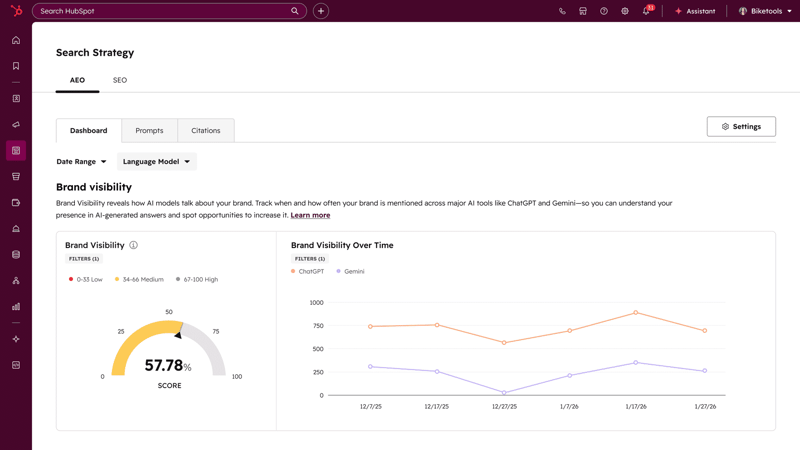
HubSpot’s AEO capabilities have evolved from a readiness assessment into live visibility and competitive intelligence across real AI platforms.
Previously, AEO focused on analyzing existing content and scoring how well it was structured for AI consumption. Useful—but limited. Teams still couldn’t see whether their brand was appearing in AI‑generated answers, how competitors were positioned, or which sources were influencing responses.
Now, HubSpot AEO tool tracks:
-
Brand presence in actual AI answers, not simulations
-
Visibility across specific buyer questions (prompts)
-
Competitive share of voice within AI responses
-
Source and citation patterns shaping what AI says
This marks a shift from theory to reality—from “Are we ready?” to “How are we showing up right now?”
Why This Matters
Without insight into AI‑driven discovery, teams are flying blind at a critical stage of the buyer journey.
Brands may see declining organic performance without realizing that the same questions are being answered elsewhere. In some cases, AI may be recommending competitors—or describing a brand inaccurately—without any signal surfacing in traditional reporting.
This expanded AEO capability helps close that gap by:
-
Making AI visibility measurable
-
Revealing competitive positioning in AI‑generated answers
-
Identifying which content types and domains actually influence AI responses
Instead of guessing how to optimize for AI discovery, teams can now act on real data tied to specific buyer questions.
2) Prospecting Agent Expands into a Complete Sales Prospecting Solution
>>This feature is available on Professional and Enterprise tiers across Sales Hub.
Sales teams have more data than ever, yet reps still spend a disproportionate amount of time researching instead of selling.
Finding the right accounts, identifying the buying committee, monitoring signals, and personalizing outreach often requires jumping between tools—LinkedIn, data providers, spreadsheets, and the CRM—before a single message is sent. The result is slower prospecting, missed opportunities, and inconsistent execution.
As buying cycles become more complex and signal-driven, that fragmented workflow has become a real constraint on pipeline growth.
What's New
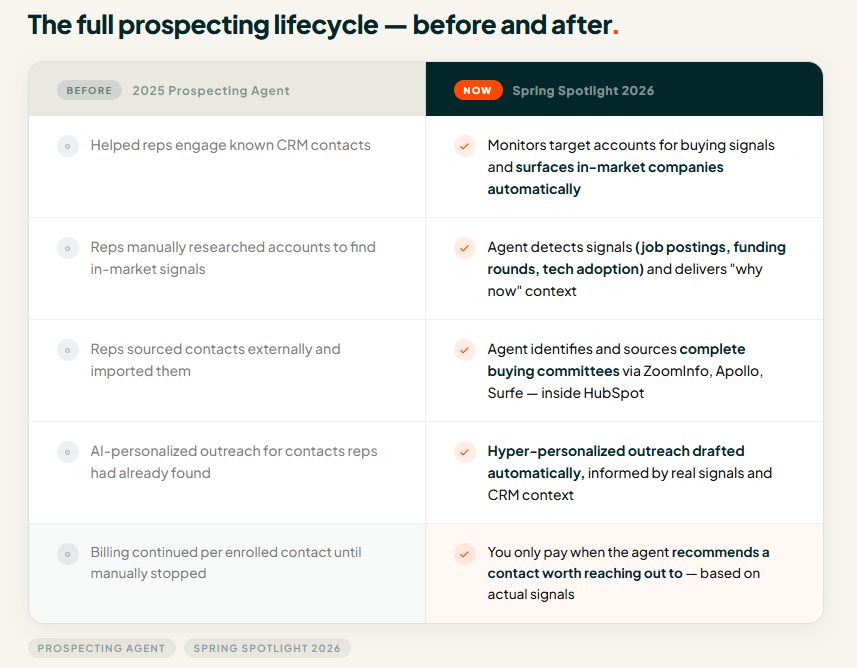
HubSpot’s Prospecting Agent has evolved from a research assistant into a more complete prospecting solution inside Sales Hub.
Built directly into the CRM, Prospecting Agent now helps reps:
-
Prioritize accounts based on real buying signals
-
Identify and source complete buying committees
-
Generate personalized, signal‑informed outreach at scale
Instead of starting each day with a static account list and a blank page, reps begin with a ranked view of which accounts are most likely to be in‑market—and why.
Why This Matters
Traditional prospecting breaks down in three key places:
-
Reps don’t know which accounts are ready to buy
-
Buying committees are often incomplete or outdated
-
Personalization takes time that doesn’t scale
Prospecting Agent addresses all three by shifting prospecting from a manual task to a guided workflow.
Signals such as hiring activity, funding announcements, technology changes, and engagement spikes are continuously monitored. When intent appears, the agent surfaces the account with clear context on why it matters now. From there, it helps reps build out the full buying group, enrich missing data, and draft outreach informed by what’s actually happening at the prospect’s company.
The result isn’t more automation for automation’s sake—it’s better prioritization, better conversations, and time redirected back to selling.
Notes / What to Know
Prospecting Agent uses HubSpot credits, and requires paid seats in Sales Hub.
3) New Customer Agent Updates to Make AI Support Easier to Use and Scale
>>This feature is available on Professional and Enterprise tiers across all hubs.
Support teams are under pressure from two directions at once.
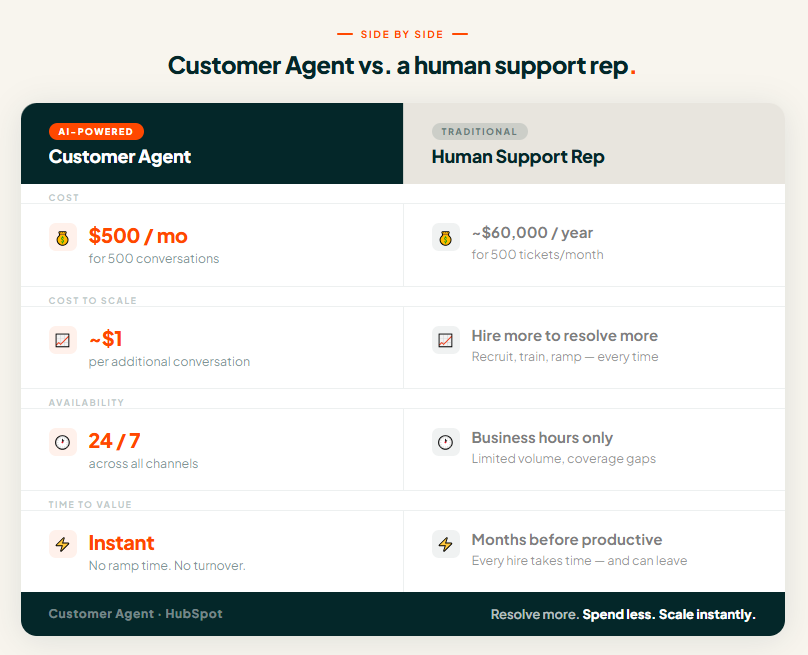
Ticket volume continues to rise, driven by product complexity and customer expectations for instant responses. At the same time, hiring and scaling support teams is increasingly expensive and slow. When volume grows, the default solution has been to add headcount—but that approach comes with recruitment costs, ramp time, limited coverage hours, and burnout across teams.
The result is an unsustainable equation: customers wait longer for answers, while skilled support reps spend the majority of their time answering repetitive, low‑complexity questions.
This is exactly the gap AI‑powered support is designed to address—but adoption hasn’t been frictionless.
What's New
HubSpot introduced a set of updates to Customer Agent focused on making adoption easier, safer, and more flexible.
Key improvements include:
-
A new 28‑day free trial for eligible customers, allowing teams to test Customer Agent in real scenarios without consuming paid credits
-
Multi‑Brand Support (public beta), enabling distinct agents for different brands, audiences, and knowledge bases
-
Email Testing Previews, so teams can validate email responses before enabling the channel
-
Defined Working Hours, giving teams control over when the agent responds
-
Workflow‑based deployments, allowing structured rollout conditions
-
Percentage Rollouts, enabling gradual exposure to live traffic
-
Email Ignore Lists, ensuring sensitive conversations route directly to humans
Together, these updates focus on one goal: reducing risk while increasing confidence in deploying AI‑powered support.
Why it matters
Customer Agent is already HubSpot’s most widely adopted agent—and customers are realizing value quickly.
Support teams report that a large percentage of inbound tickets fall into predictable categories: password resets, billing questions, and basic how‑to requests. These aren’t difficult issues, but they consume time, raise costs, and limit the availability of support teams for higher‑value work.
The latest updates make it significantly easier to:
- Pilot AI support without long‑term commitment
- Maintain brand accuracy and trust across multiple products or audiences
- Validate response quality before exposing customers to it
- Scale usage gradually instead of all at once
This shifts Customer Agent from an all-or-nothing decision into a controlled, phased rollout—one that aligns with how real teams adopt new capabilities.
Notes / What to Know
After the trial, Customer Agent uses HubSpot Credits and requires configuration and deployment to a channel to start the trial.
Subscribe now to get the latest HubSpot updates and AI features delivered straight to your inbox, or talk to our team for personalized guidance!



Blog comments