
- Industry
- Energy & Utility, Home Services
- Duration
- 12-week implementation
- Type
- B2C
- Solutions
- HubSpot re-implementation, custom system architecture and strategy, custom Cargas integration
HubSpot products used
-

-
Marketing Hub®
Professional
-

-
Sales Hub®
Professional
THE CHALLENGE
Prior to this engagement, Homestead was already using HubSpot and Cargas Energy (their ERP). However, the existing HubSpot setup was architectured to support their multi-service model only from a lead-generation perspective and lacked the architecture needed to track end-to-end sales performance or ROI.
Combined with a limited integration to Cargas, this prevented a unified customer view and made cross-sell execution and measurement difficult.
Customer data lived in silos across service lines
Homestead could see fuel customers, HVAC customers, plumbing customers, and efficiency customers, but only in isolation.
A single homeowner who purchased multiple services could appear as separate records or with disconnected history, and while the customer existed in both HubSpot and Cargas, no sales data was available to produce a unified record. This made it difficult to understand the full customer relationship.
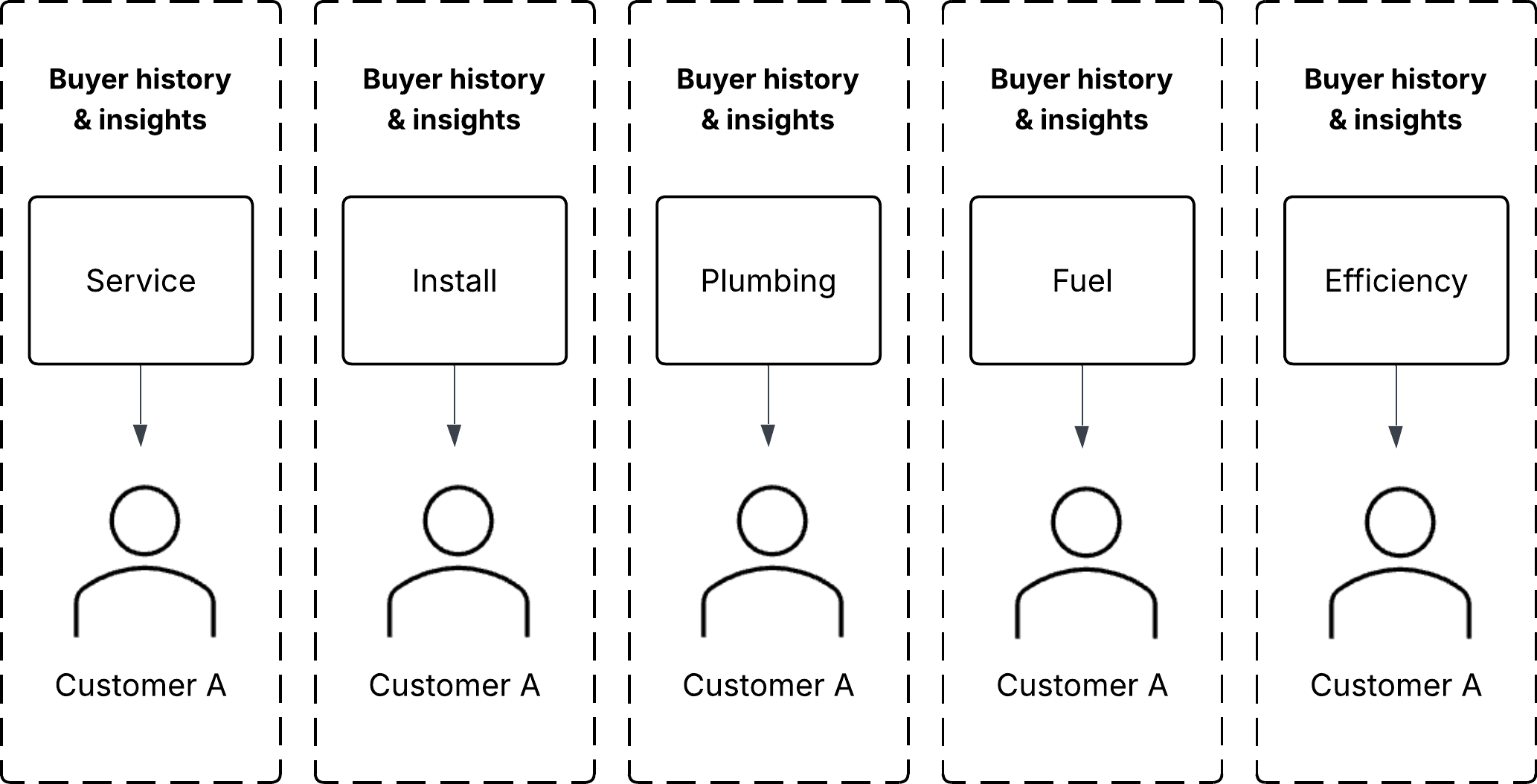
Customer A = single homeowner
Cross-sell execution was difficult to scale
Homestead knew existing customers, especially fuel customers, were strong candidates for HVAC, plumbing, and efficiency services. But without a unified customer view, there was no scalable way to reach the right customers with the right message at the right time.
We’ve never done targeted re-marketing for cross‑sell and connecting revenue to the CRM is going to be powerful. We have about 18,000 customers in a tight geography, and the fuel‑customer map alone showed how much opportunity exists for personalized outreach and re-marketing near our refuel locations.”
- Peter Faulk, Head of Marketing, Homestead
No visibility into “current” vs. “former” customers
Homestead could identify who had ever purchased a service, but not who was an active customer within each service category. This limited segmentation accuracy and risked mistimed or irrelevant outreach.
Broken customer journey data and incomplete revenue attribution
Marketing activity lived in HubSpot, while service fulfillment and billing lived in Cargas. After a marketing form submission, much of the sales and customer success process moved outside HubSpot, which made it difficult to connect marketing efforts to closed revenue, service category performance, or customer lifetime value.
“We knew who our customers were—but we don’t know how they overlap, or how to reach them effectively across services.”
- Peter Faulk, Head of Marketing, Homestead
THE SOLUTION
accelant re-architected HubSpot around Homestead’s multi-service operating model and designed the foundation for a tighter connection with Cargas.
The team began with deep discovery focused on how Homestead’s business, services, and customer lifecycle truly operate. This discovery informed how customer data needed to be structured, how services should be categorized, and how HubSpot and Cargas should interact across the customer journey.
Building a customer-centric HubSpot system architecture
Homestead’s business spans fuel delivery, HVAC installation and service, plumbing, and energy efficiency programs.
But prior to accelant’s involvement, there was no structured way to see a homeowner’s complete relationship across those service lines.
1) Defining and tracking clear customer segments
accelant worked with Homestead to define service-based customer categories inside HubSpot:
- Fuel deliveries
- HVAC Installation
- HVAC Services
- Plumbing
- Water treatment
- Energy Efficiency
Although Cargas provided a customer-level integration for fuel deliveries, it only surfaced the most recent delivery details, not the full delivery history. This further reinforced the need for a unified segmentation framework.
Rather than treating each purchase as an isolated event, these categories allow a single homeowner record to represent multiple concurrent service relationships.
This segmentation framework became the foundation for tracking the full customer journey — from an initial service interaction to long-term retention and cross-sell opportunities years later.
“This segmentation framework solves one of our biggest challenges — connecting all our service relationships under a single customer record. Having every service category unified in one place has completely changed how we understand and serve our customers.”
- Peter Faulk, Head of Marketing, Homestead
.png?width=1913&height=1054&name=Homestead%20-%20Page%201%20(1).png)
Customer A = single homeowner
2) Mapping Cargas service data into HubSpot categories
Customer categories are only valuable if they’re accurate.
To ensure HubSpot reflects real-world activity, accelant mapped Cargas service codes and equipment types into structured service categories inside HubSpot. This ensured that:
- Service codes consistently interpreted
- Customer records reflect true purchase behavior
- Marketing and sales teams can segment with confidence
- Retarget fuel-only customers with HVAC installation offers
- Promote service agreements to installation customers
- Re-engage past service customers based on equipment lifecycle timing
- Suppress current customers from irrelevant promotions
With clean data flowing in from Cargas, HubSpot became a reliable source of truth for understanding the full customer story.
3) Enabling targeted cross-sell and re-engagement
Once customer relationships were structured correctly, Homestead could activate that data.
Instead of broad, one-size-fits-all campaigns, teams could now:
By defining segments clearly and aligning them to operational data, accelant enabled Homestead to market based on the full customer journey — not disconnected transactions.
REAL RESULTS:
In one instance, after activating these segments, a quick email campaign generated more than 40 new leads for a single department, demonstrating the direct pipeline impact of precise audience segmentation.
Building a custom HubSpot <> Cargas integration
Before accelant, Homestead had a Cargas<>HubSpot integration in place, but it was one-way and limited to basic customer-level data. It did not capture service-level detail or support a complete view of customer activity across systems.
accelant designed an integration strategy that connects HubSpot and Cargas at key points in the customer journey, with each system playing a clear role.
- HubSpot to Cargas: New leads captured in HubSpot create or update the corresponding customer record in Cargas.
- Cargas to HubSpot: When work orders and fuel deliveries are completed and paid in Cargas, that activity generates closed-won deals in HubSpot with the relevant service category and revenue details.
- Service context in HubSpot: Deal records carry the information needed to associate purchases with specific service categories.
.png?width=2404&height=1804&name=Homestead%20-%20Page%201%20(2).png)
This integration framework ensures service activity, customer status, and transactional data flow into HubSpot in a structured and intentional way.
Solving for “current customer” visibility
A critical requirement of the solution was enabling HubSpot to distinguish between customers who purchased a service in the past and customers who are actively engaged today. In Homestead’s business, a single homeowner may fall into different customer states across services at the same time.
To address this, accelant implemented dynamic, time-bound customer status tracking in HubSpot. Instead of treating customer status as permanent, the system reflects service activity over time.
- Automatically timestamps when a customer purchases a service
- Resets that timestamp with each new purchase in the same category
- Clears customer status after a defined period of inactivity, which varies by service type
This approach ensures customer status remains accurate as purchase cycles change, without requiring manual updates or ongoing maintenance.
Looking ahead
The next phase of the Homestead engagement is focused on expanding HubSpot as a cross‑functional platform that supports teams beyond sales and marketing. With the core architecture and integrations in place, Homestead is now positioned to enable HubSpot across additional departments—streamlining manual workflows, reducing reliance on spreadsheets and disconnected tools, and centralizing operational data into a single system of record.
This cross‑functional enablement will allow each team to leverage HubSpot in ways that directly support their day‑to‑day processes, further consolidating technology, improving efficiency, and ensuring Homestead captures the full value of its HubSpot investment as the platform continues to scale with the business.
THE RESULTS
A unified customer view that unlocks LTV
Homestead now has a single source of truth for each customer across fuel, service, plumbing, water treatment, and energy efficiency. By eliminating fragmented, service‑by‑service records, the team can clearly see what customers have purchased, how they’ve been serviced, and where the next expansion opportunity exists.
This visibility gives Marketing and Sales the insight needed to communicate more precisely, market more accurately, and spot the right moments to expand customer relationships—ultimately accelerating customer lifetime value.
Accurate customer status improves cross-sell opportunity and customer experience
With dynamic customer status tracking in place, Homestead can distinguish between active and inactive customers within each service category. This makes it easier to build targeted audiences for cross-sell and re-engagement based on real service usage and timing.
Teams are no longer relying on static labels that quickly become outdated and can often lead to mistimed or misdirected communications to customers.
Customer insights at scale drive faster new customer acquisition
By combining Cargas service data with unified HubSpot records, Homestead can now clearly identify its highest‑value customers and activate them with precise, data‑driven messaging.
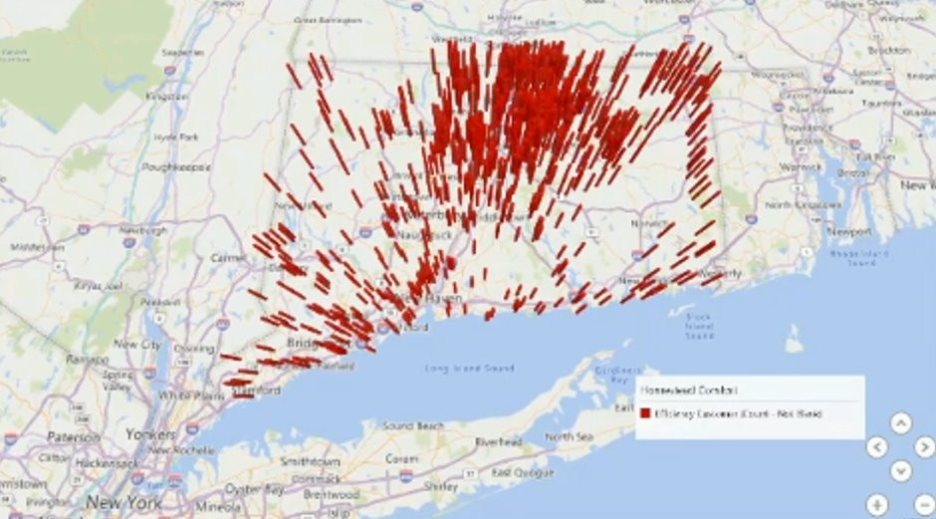
PowerBI visual incorporating HubSpot and Cargas data points highlighting Homestead’s market opportunity
Instead of broad outreach, the team can target the customers most likely to convert—fuel‑only accounts ready for HVAC, installation customers primed for service agreements, former customers who can be reactivated, and high‑opportunity geographic clusters. This targeted, insight‑based approach has already proven effective, generating 40+ new leads from a single segmented email campaign.
End‑to‑end campaign attribution fuels smarter growth investments
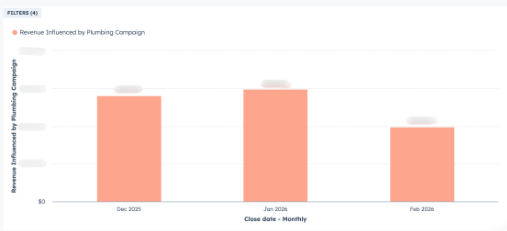
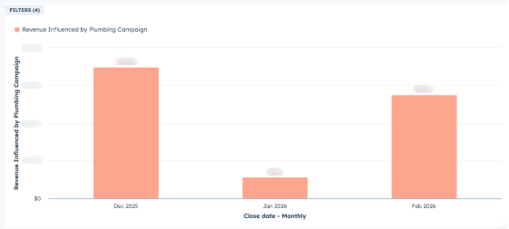
Homestead can now track the full lifecycle of a marketing‑generated lead — from the first campaign interaction all the way through service completion and closed‑won revenue. When a contact engages with a campaign asset, that engagement flows into HubSpot, links to the corresponding Cargas work order once scheduled and completed and ultimately connects to the closed‑won deal.
This end‑to‑end attribution gives Homestead a clear understanding of which campaigns actually drive revenue and allows Marketing to optimize spend based on real service outcomes.
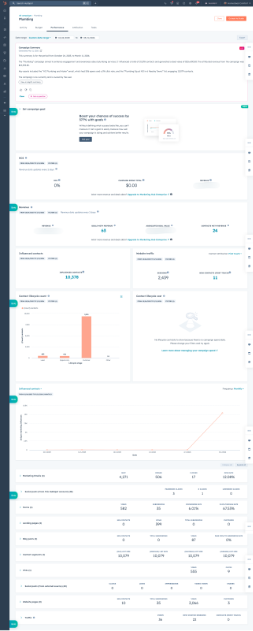
Service activity connected to revenue in HubSpot
Service-level deal data flowing into HubSpot gives Homestead visibility into what customers purchased and when. This supports clearer attribution and a stronger understanding of performance by service line. With service outcomes captured in HubSpot, marketing and operations reporting becomes easier to manage and act on.
